

Table of Contents
ToggleDefinition Of SEO
“SEO stands for search engine optimization, which is a set of practices designed to improve the appearance and positioning of web pages in organic search results.”
Introduction to SEO
Whenever you do SEO, always remember one thing: “The foundation of SEO remains the same.” this means that the foundations or basics of SEO always stay the same. Many people, when doing SEO, start looking for various hacks, tips, and tricks, but they forget the basics of SEO. We tell you that if you implement the basics correctly, you won’t need any tips and tricks.
Let’s assume for a moment that your website does rank, but if you’ve done its SEO using black hat techniques or by using tricks to rank your website, then as soon as the next Google update comes or the Google algorithm is updated, your website will disappear from the search engine results page.
How Google's Algorithms Work
The guidelines and methods that Google uses to determine which websites appear at the top of search results and in what order are called its algorithms. In other words, when you search for something, Google’s algorithms examine millions of web pages to provide users with the most relevant, helpful, and trustworthy information.
So, as you all know, Google, as a search engine, operates on algorithms. If we talk about the types of algorithms used in the Google search engine, or the types of algorithms used to display the results when we search for something on Google, or the types of algorithms Google uses to crawl and index its web pages, there are two types of algorithms: core algorithms and other algorithms that are updated from time to time according to requirements.
We are talking about core algorithms, and the core principle of these algorithms is that if your content has value, that content will rank; if your content is relevant to the user’s query, your content will rank. These are the core aspects of the algorithm; they form the Base of the algorithm, and these things don’t change. Based on these algorithms, Google has given us certain recommendations. Google has stated that if we follow all these steps, our website will rank. And these are the very steps we study in SEO. SEO is actually a process through which we rank our web pages in search engines. The multiple steps or tasks we see in SEO are all based on Google’s recommendations.
So, if we try to carefully understand Google’s recommendations –what Google is recommending and why, and how Google’s Base algorithm performs crawling, indexing, and ranking websites – then everything will become clear to you. In other words, if your foundation is strong, SEO will seem very easy.
History of SEO
SEO (search engine optimization) is not a recent term; it’s quite old. As the internet and the world wide web (www) became more popular, many businesses started creating their own websites. This Led to the creation of numerous websites across various categories and niches. The internet continued to grow in popularity, with thousands of websites being created every day.
The problem was that while these websites were being created for users, users weren’t able to find them. Business owners, or website owners, became frustrated because their websites weren’t reaching their target audience. They realized there needed to be a way for users to access all these websites. So, before search engines, web directories were created, and websites were categorized within these directories.

However, websites were growing so rapidly and in such large numbers that web directories couldn’t keep up. This Led to the birth of search engines. Users would go to a search engine, enter their query, and the search engine would display the most relevant web pages. The first search engine was yahoo; Google came much later. Google understood that to survive in the market, they needed to provide users with accurate and relevant results. Yahoo failed to grasp this, which is why it didn’t become as popular and eventually faded away. Google, on the other hand, came into existence after yahoo and remains incredibly popular today. the SEO we study today is essentially based on Google’s algorithms and practices.
After all this, even more websites started appearing, and business owners began to realize the power of websites. People understood that the world was becoming increasingly active on the internet, that people were browsing websites, and that if their website reached a wider audience, their business would grow. So business owners started thinking about what they could do to ensure that whenever someone typed a keyword related to their products or services into a search engine, their website would rank in the first position. Following this, all the business owners and people involved in digital marketing began to study and understand how search engines actually work, and how a search engine brings a website to the first position.
Google had already informed its audience that if they implemented certain best practices on their website, they too could rank in the first position. These best practices are what we implement during SEO. Google also explained how it performs crawling, indexing, and ranking.
So, search engines existed before SEO began, and the need for search engines arose because so many websites were being created on the internet, and these websites weren’t reaching users. Search engines became the mediators between users and websites, delivering relevant websites and web pages to users. This gave birth to a new concept called search engine optimization (SEO).
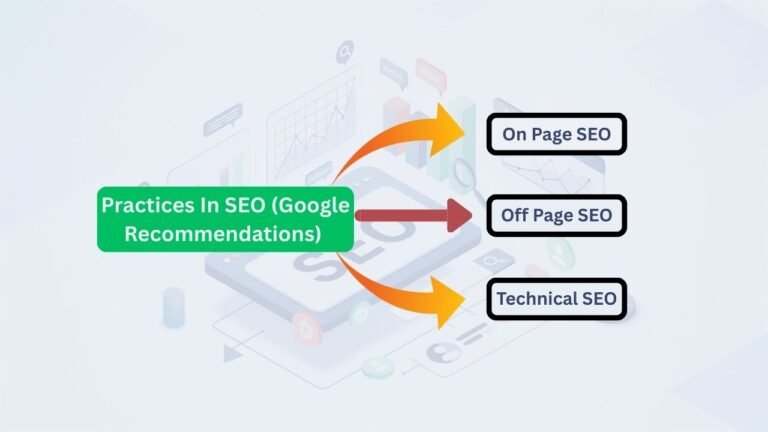
As you saw in the definition, SEO is a set of practices, and we divide these practices into three major categories:
Practices in SEO (Google Recommendations)
In all these SEO practices, we follow Google’s recommendations because if we don’t follow Google’s recommendations and Google introduces an update in the future, we won’t be able to maintain our ranking in the search engine. When we make changes to our website, it’s called on-page SEO. Off-page SEO generally includes our backlinks, meaning how we create as many high-quality links as possible. All these activities fall under off-page SEO. In technical SEO, we look at some other SEO activities, such as whether our website has an SSL certificate, our website speed, mobile-friendliness, etc.
So, if you follow Google’s recommendations effectively, your website’s SEO will be better. When you do SEO, you will also have to face challenges because you are not the only one doing SEO; your competitors are also doing SEO. It’s also possible that the particular keyword you are trying to rank for is the same keyword your competitor is also trying to rank for.
People Practicing
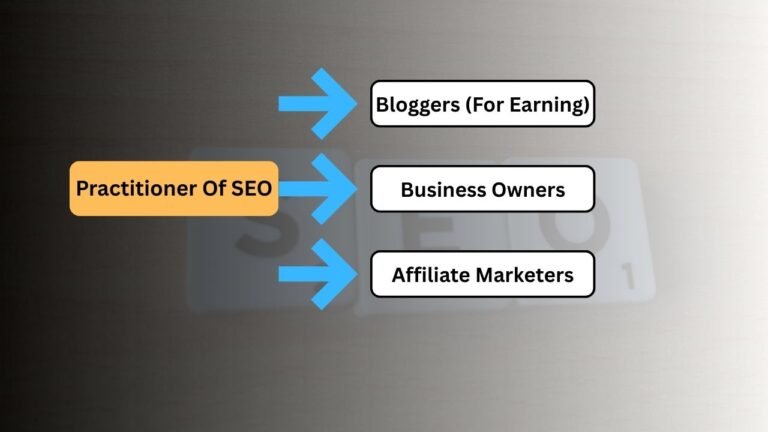
Now we will talk about who practices SEO or for whom SEO is intended.
Bloggers (for Earning)
When a specific topic is explained in detail through written content, it is called a blog. Nowadays, there are many bloggers who are learning and implementing SEO for the purpose of earning money. They create informative blogs within a specific niche, and they do all this for the purpose of earning. They can have multiple ways of earning, for example, they can earn through sponsorships and adsense. Ultimately, a blogger’s earning is only possible when their content or blog ranks for a specific keyword, which brings traffic to their website.
Business Owners
Nowadays, there is hardly any company or business that doesn’t have its own website. So, business owners also need SEO. For example, a business owner who runs an IIT coaching institute would want their website to appear first when someone searches for “Best IIT coaching” on a search engine. This is so that more and more traffic comes to their website, and they can sell their products or services.
Affiliate Marketers
Business owners who want to sell their products or services look for people whose websites have a lot of traffic or who have a large number of subscribers or followers on their social media platforms. Then, the business owners provide them with a link to their product or service, which is called an affiliate link. When a product or service is sold through this link, that person or affiliate marketer receives a commission. Affiliate marketers then write content related to that product or affiliate link and rank that content. Because only when the content ranks will traffic come to their website, and they will earn a commission for the product or service they recommended through their affiliate link.