


Table of Contents
ToggleWhat is Search Engine
“A Search engine is a software system designed to search out the information from world wide web according to user’s query.”

In other words, a search engine is a type of system software; when a user types or searches for a keyword or query related to a specific topic, the search engine retrieves relevant information from the data available across the World Wide Web and presents it to the user.
The Importance of Search Engines
Let’s consider what our lives would be like without search engines. Suppose you want to find out the price of a Ferrari; you would simply type “price of Ferrari” into Google, and a multitude of relevant websites and information would appear. Without a search engine, however, how would you know which website lists the Ferrari’s price? You would have to memorize the exact URL of the specific website or webpage you needed to visit and enter it directly into your web browser.

Thanks to search engines, we can now search for the Ferrari’s price directly and get the information instantly. Without them, we would have had to memorize the URLs for every single website—much like we used to memorize phone numbers in the past—and keep track of which website contained which specific information, which would have been incredibly difficult. You can see, then, just how much search engines have simplified our lives.
Top Search Engines
When discussing search engines, you might wonder if Google is the only one. That is not the case; there are many search engines in the world. While Google is the most well-known, the top three are Google, Yahoo, and Bing—ranking in that order. This holds true whether looking at global usage or usage within India.

However, there are several other search engines globally. One is “Baidu,” which is extremely popular in China, where 85% of the audience uses it. Another is “Yandex,” a very popular search engine in Russia; the Russian audience is split, with 50% using Yandex and 50% using Google. Additionally, for those concerned about privacy, there is a search engine called “DuckDuckGo.” It is preferred by privacy-conscious users because it does not save user data, whereas Google has been found to store data in many instances.
How Search Engines Work (Step by Step)
we will understand how search engines work. When a user makes some query in the search engine, then in response to that he sees many results in the search engine result page (SERP). How do all these results come, how does Google show these results because there are many websites on the internet, then why do only some specific websites appear to us in a specific order. We will try to understand all these things in this particular blog. Along with this, we will understand how Google crawls, indexes and ranks websites.
1. Crawlers Visit Different Websites
Google has some crawlers, also known as Google bots or spiders. Crawlers are Google programs or software that visit different websites on the Internet and collect information from them. However, there are so many websites on the Internet that crawling them is not easy for crawlers. It’s not that websites have stopped being created; new websites are being created every day, and the job of these crawlers, bots, or spiders is to visit all the new websites that are coming up.
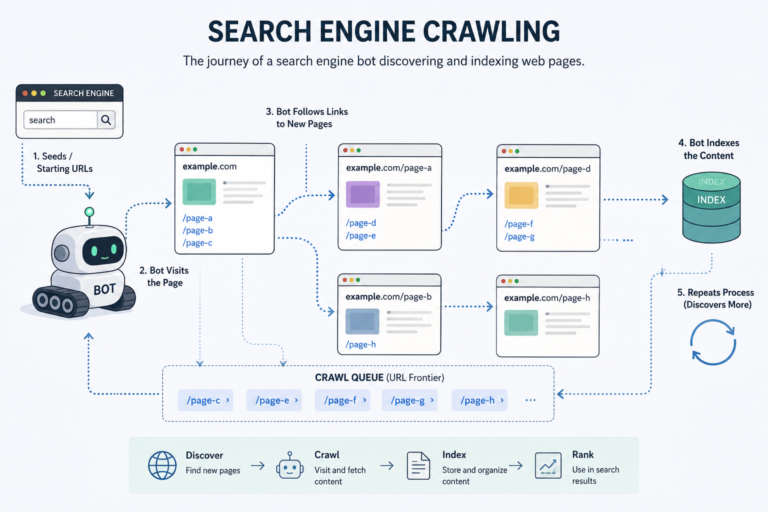
So now the question arises: how will the crawler know that a new website has appeared and that it needs to monitor, crawl, and collect information about that website? The primary method used by crawlers for this is links. For example, suppose there is a website named “X” and a new website named “Y” has been created, and a link to this website “Y” is available on “X.” If the crawler is visiting website “X,” it will reach website “Y.” This is one method, and the second method is that almost all website owners create their own Google Search Console account, and with the help of this account, the crawler monitors your website
So friends, crawlers reach our website from some source or the other. Sometimes it takes some time to crawl or visit the website, but somehow the crawlers reach the website.
2. Crawlers Crawls And Understand the Websites
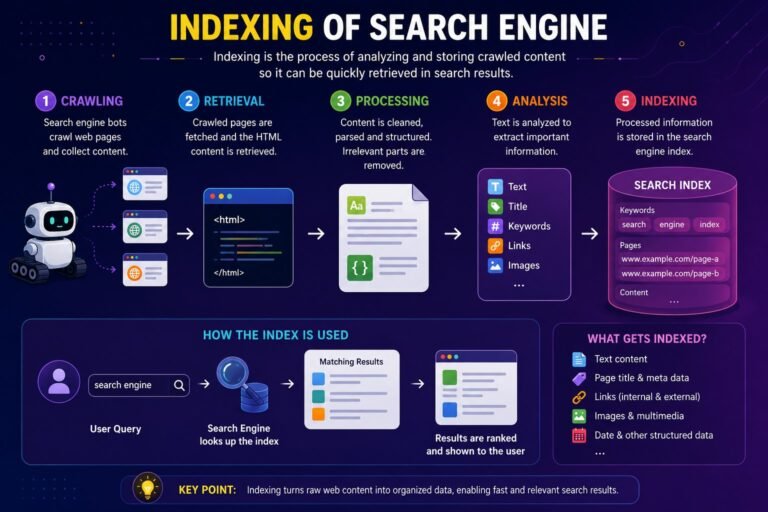
When Google’s crawler visits a website, it scans the entire website, including all its content and source code, and attempts to understand the website’s topic and information. The title, description, headings, images, and content on a webpage give the crawler an idea of what a particular webpage is about. Important keywords are included in the title, description, and content. This helps the crawler understand what a particular webpage is about or what topic the content addresses. This process is called crawling.
3. Indexes Different Websites
When Google collects information about a website, that is, when it determines the niche of a particular website, the crawler indexes it into Google’s database. Indexing means that the crawler will store the website in its database and mention its niche. Similarly, Google’s crawler visits different websites, collects information about them, and stores it in Google’s database according to their niche or category.
4. Ranking Algorithms - Displays Results
Users generally don’t know much about Google’s processes. They simply go to Google and enter their query. When a user queries something, Google’s algorithms check the database created by crawling and indexing various websites to determine which website is relevant to the particular query.
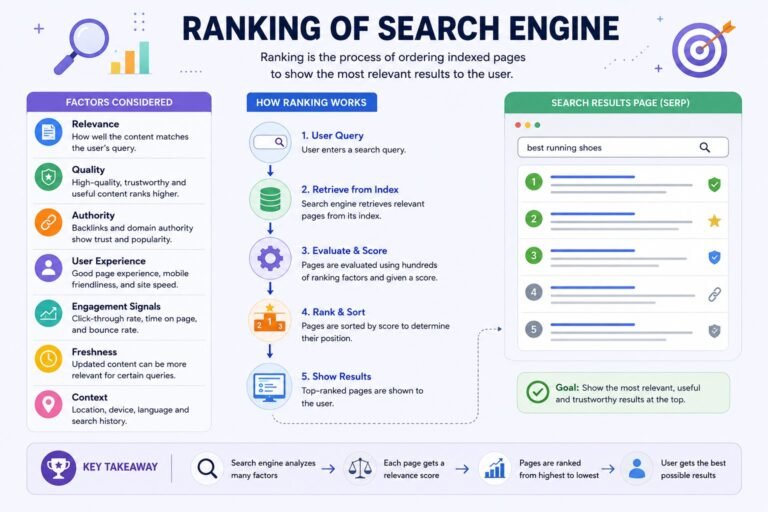
Suppose a user has entered a news-related query, and Google’s database contains 100,000 news-related websites. Now, the question arises: how will the order on the SERP (Search Engine Result Page) be defined, meaning how will it be decided which website will appear first and which last? Because there are so many websites, we can’t assign the first position to all of them. Now Google has to display the results and the results are displayed in SERPs and the results displayed in SERPs have their own order, that is, there is a sequence of which website is on the first position, which is on the second, which is on the third, and which is on the fourth. Now here comes the role of Ranking Algorithms. Google’s Ranking Algorithms decide which website is most relevant to the user’s query and how and in what order the website will get ranked.
Conclusion
So we have seen how Google as a search engine works. Be it Google or any other search engine, it works in almost the same way. All search engines have their own bots. They keep visiting different websites, collect information from there, understand the nature of the website and on the basis of that nature, store that website in their database. There are millions of websites in the database and when the user makes a query, the search engine maps which websites match the user’s intent or the user’s query and shows them to the user on the basis of Ranking Algorithms.